
Happy Halloween everyone! 🧛
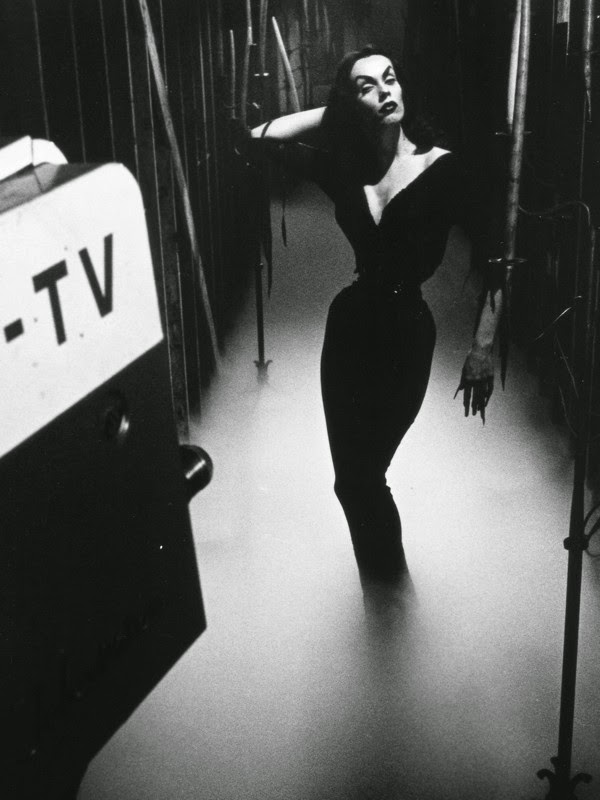
For this month’s post, I wanted to pay a special tribute to one of history’s most beloved and iconic glamor ghouls: Vampira. The alter ego and passion project of actress Maila Nurmi, Vampira was TV’s original horror movie commentator who played an integral role in the development of goth and camp culture in the United States. She was also a personal friend and collaborator of Liberace’s who credited him with (briefly) reviving her career in the 1950s!
(Photo credit: Austin Film Society)
(Photo credit: Hometowns to Hollywood)
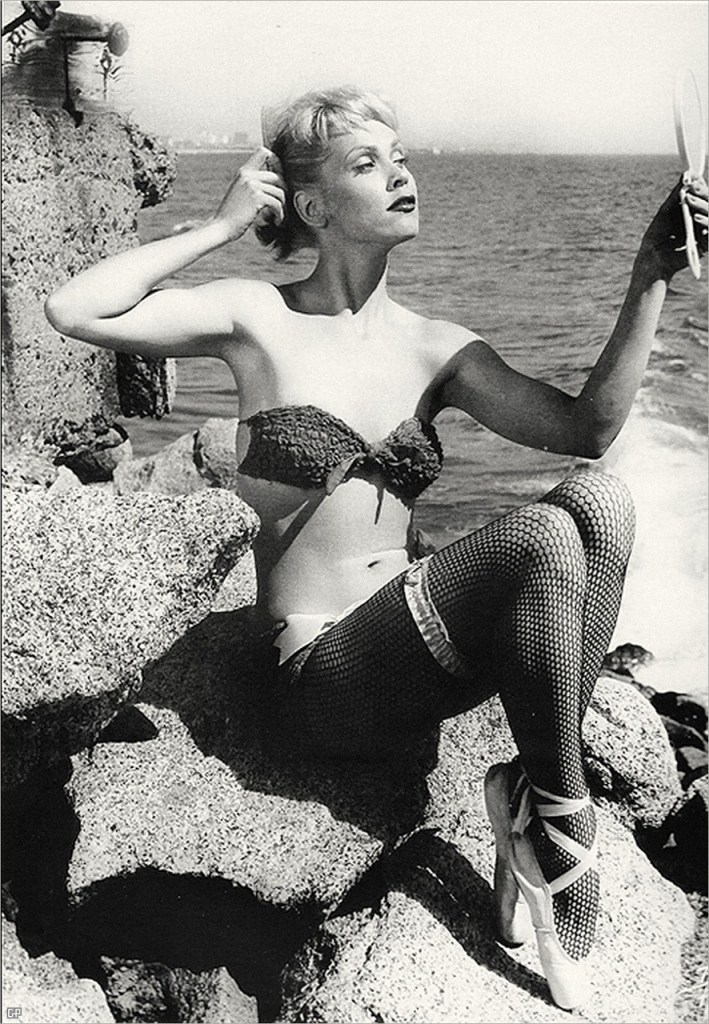
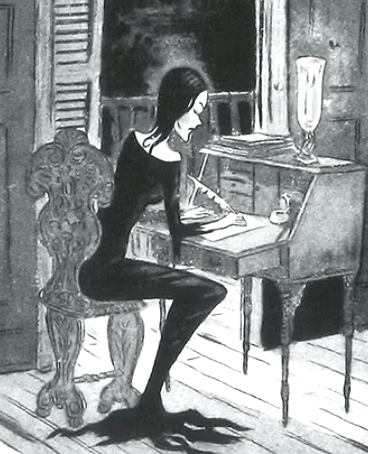
Maila Nurmi was born Maila Elizabeth Syrjaniemi on December 11th, 1922.1 The daughter of Finnish immigrants raised primarily along the Oregon coast line, Nurmi would begin her show business career as a dancer, show girl, and pin-up model in New York City before relocating to Los Angeles in the early 1950s.2 There, she would meet choreographer Lester Horton who would invite her to attend his annual Bal Caribe costume party in 1953.3 Eager to impress Horton and the dozens of other celebrity guests expected to attend his party, Nurmi would create her first iteration of the Vampira character – a “campier and sexier” take on Morticia Addams complete with a tattered black dress, vampy bold make-up, and cartoonish red fingernails.4
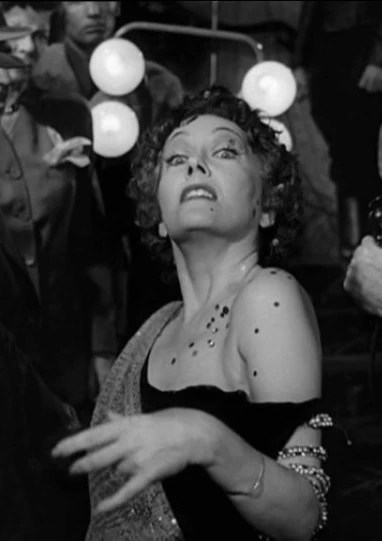
“I had all sorts of things that you didn’t see on women in those days,” Nurmi recalled in a 2008 interview. “I took [inspiration from] cheescake [pin-up modeling] and John Willie’s book Bondage and Discipline, and I cinched her waist. Then I got some phallic symbols going like a long cigarette holder, y’know, black. Then I put in the fishnet holes, a slit in the dress. I changed Morticia’s statement. I gave her Hollywood make-up and the glamor hair with a little disarray. And then I took on the attitude of the cheescake [model], but remembering too that there was a bit of Greta Garbo in [her], and something a little Dostoevsky, and something just a wee bit spooky – Norma Desmond who had just turned me on big in Sunset Boulevard.”5
(Photo credit: Charles Addams)
(Photo credit: Paramount Pictures)

(Photo credit: Listal)
Nurmi’s Vampira costume so completely “transfixed” local TV producer Hunt Stromberg Jr. that he immediately offered her a role as a movie presenter on KABC-TV Los Angeles.6 The Vampira Show would debut on April 30th, 1954 and would feature Nurmi as Vampira introducing a selection of B-grade horror movies from her haunted lair.7 Essential to the show’s success was Nurmi’s self-written “graveyard humor” which included a campy assortment of puns about death, ghouls, and murder.8 “This is Vampira,” she’d croon at the end of every episode, “until next week – wishing you bad dreams darling.”9
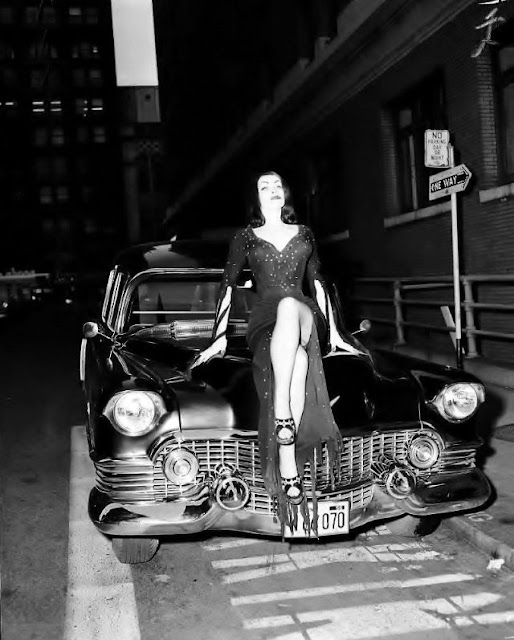
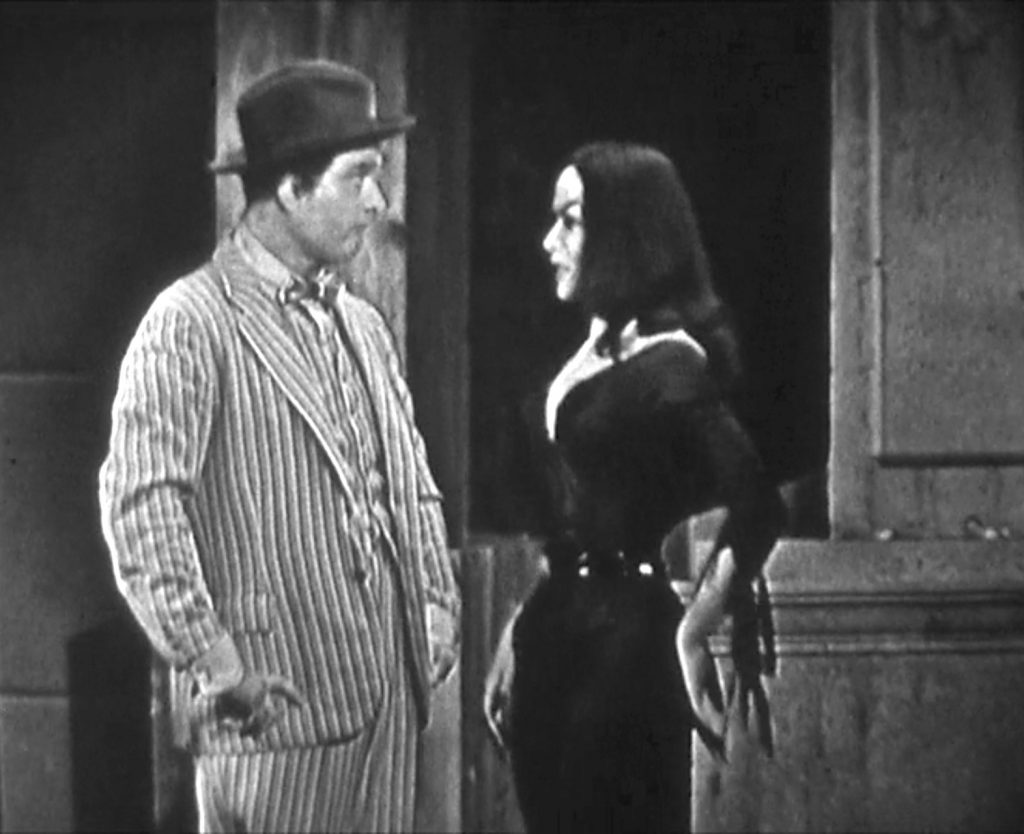
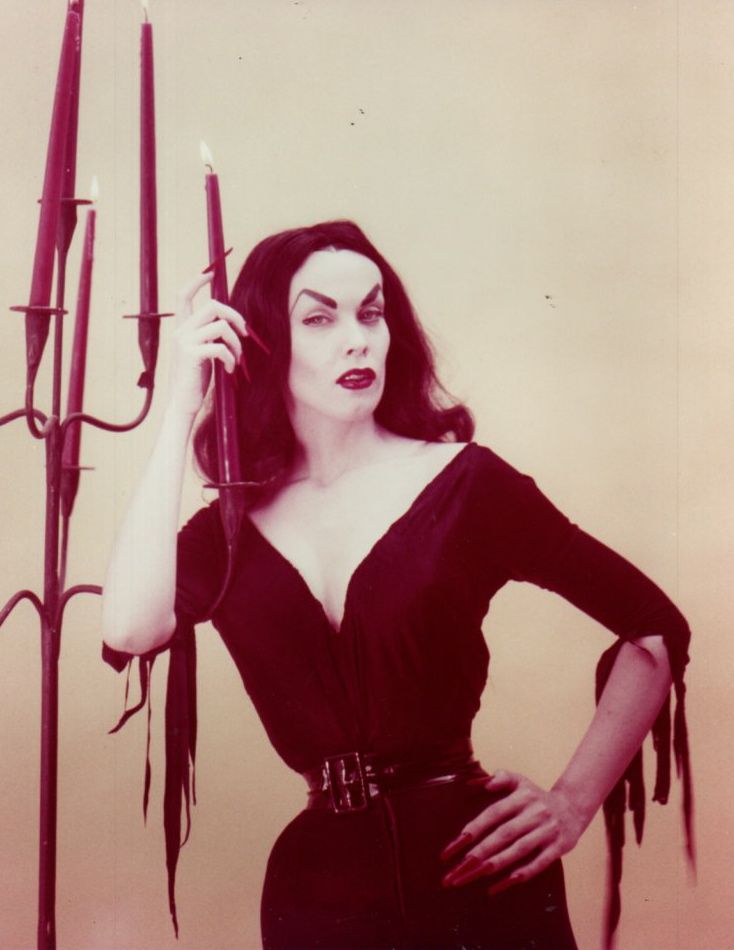
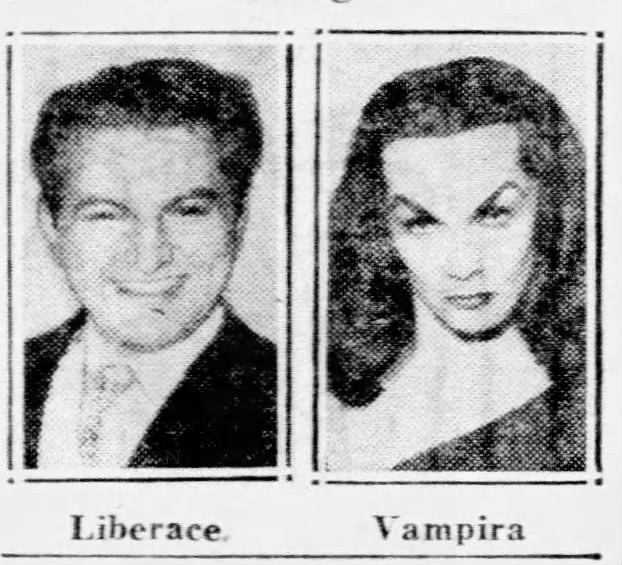
Although The Vampira Show aired close to midnight and had an unusually macabre premise for the 1950s, it would prove to be a smash hit with LA audiences.10 Nurmi’s commitment to appearing in public as Vampira only heightened buzz around the character who fans could spot cruising up and down Hollywood Boulevard in her custom Packing touring car and bat-shaped sunglasses.11 Like Liberace, Nurmi understood the importance of theatrics and showmanship, and worked to incorporate both into her routine with campy precision. While it’s unclear where or when Nurmi first met Liberace, it’s likely that their paths initially crossed while they were working on their highly popular TV shows in Los Angeles. “[Maila] comes on [TV] like a Charles Addams cartoon,” Liberace enthused in 1956. “She has a 17-inch waist and a 39-inch bust. Her black dress is in tatters – but jeweled. Her fingernails are like claws.”12
(Photo credit: Momentos del Pasado)
(Photo credit: Red-Skelton.Info)
(Photo credit: Pinterest)
(Photo credit: The New York Daily News)
By 1955, the unexpected success of The Vampira Show had begun to drive a wedge between Maila Nurmi and KABC-TV. Fearing that Nurmi had too much power in her dual-role as star and creator, KABC executives demanded that she sign over all rights to the Vampira character to their network before they would agree to produce another season.13 When Nurmi refused, KABC responded by canceling The Vampira Show – a sudden and vindictive move which left Nurmi jobless and shaken to her core.14 “Hollywood is a very cruel place,” she’d tell the Valley Times’ Allen Rich in 1956. “It can break your heart.”15
Sympathetic to Nurmi’s plight after experiencing his own highs and lows in TV land, Liberace would approach Nurmi about collaborating on a new musical revue show he was putting together in Las Vegas.16 Originally titled “Liberace’s Bridey,” the show was intended to be a camp parody of housewife Virginia Tighe who’d made headlines in 1952 after “discovering” she’d once been an Irish woman named Bridey Murphy during past-life hypnotherapy.17
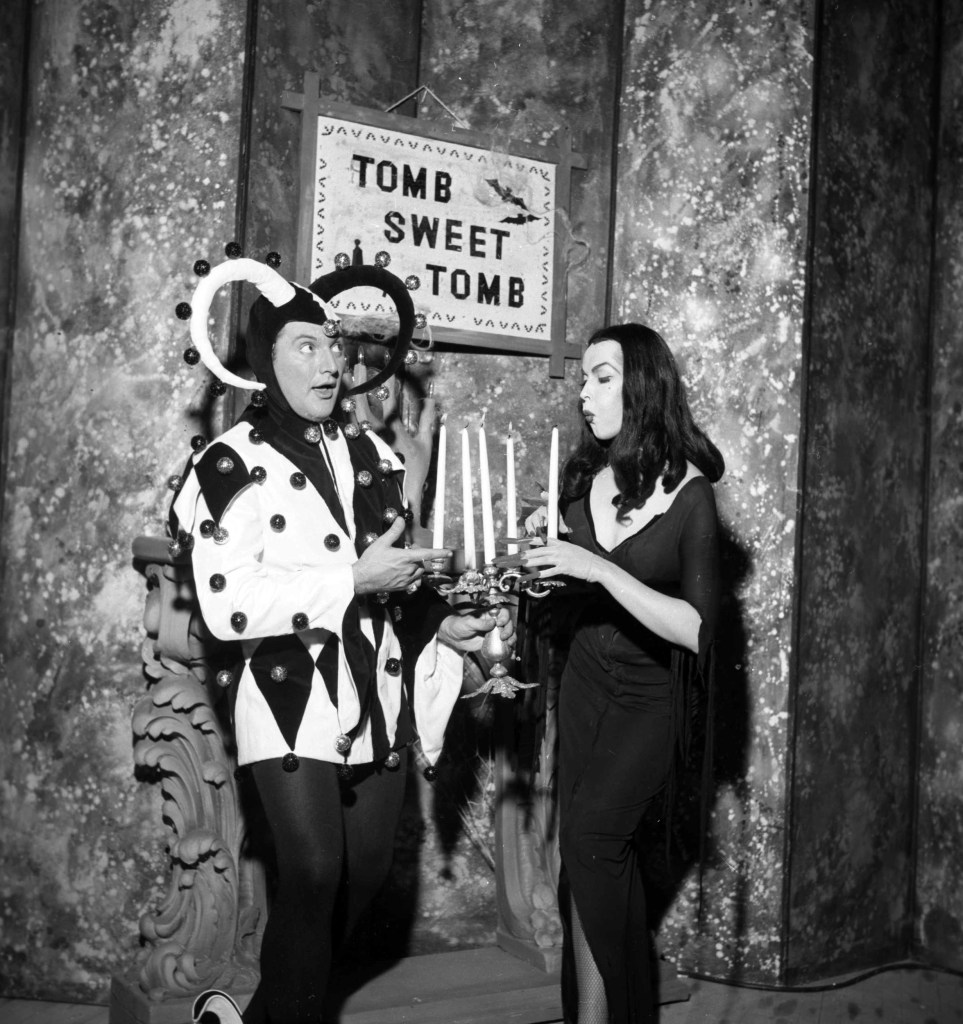
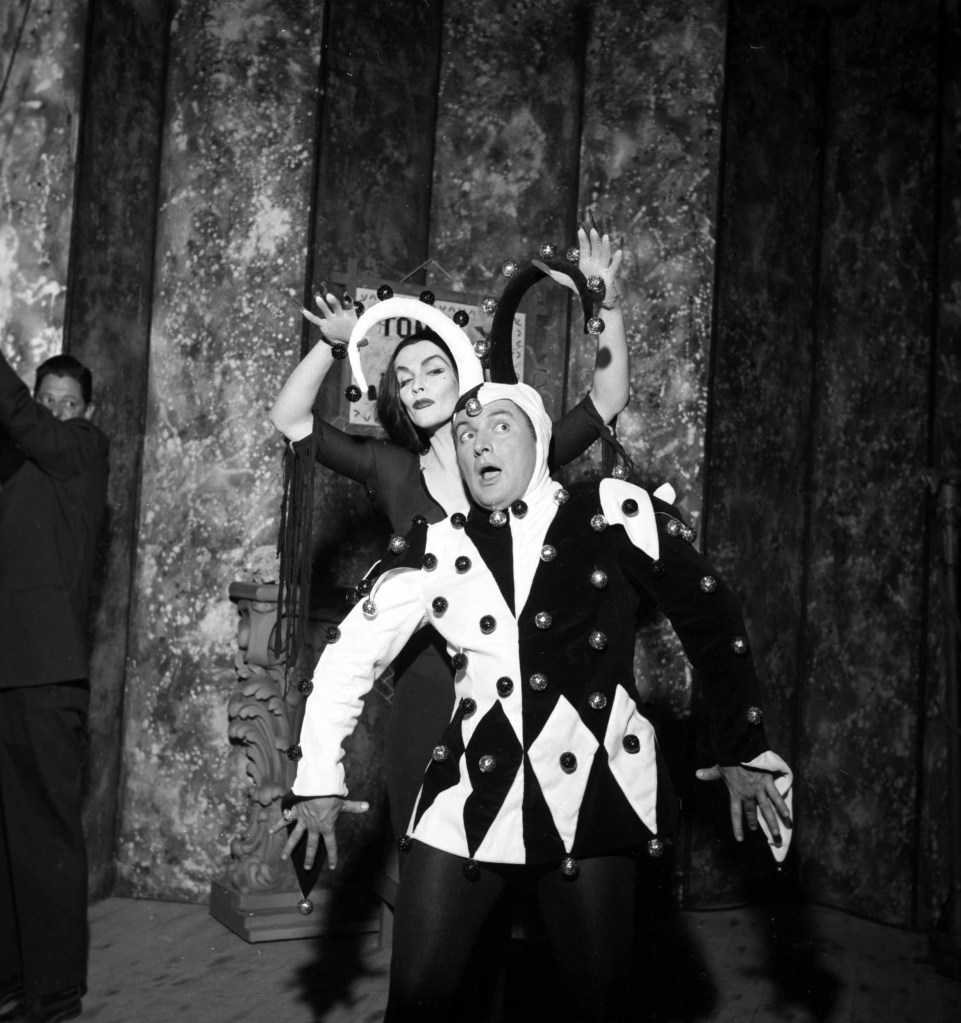
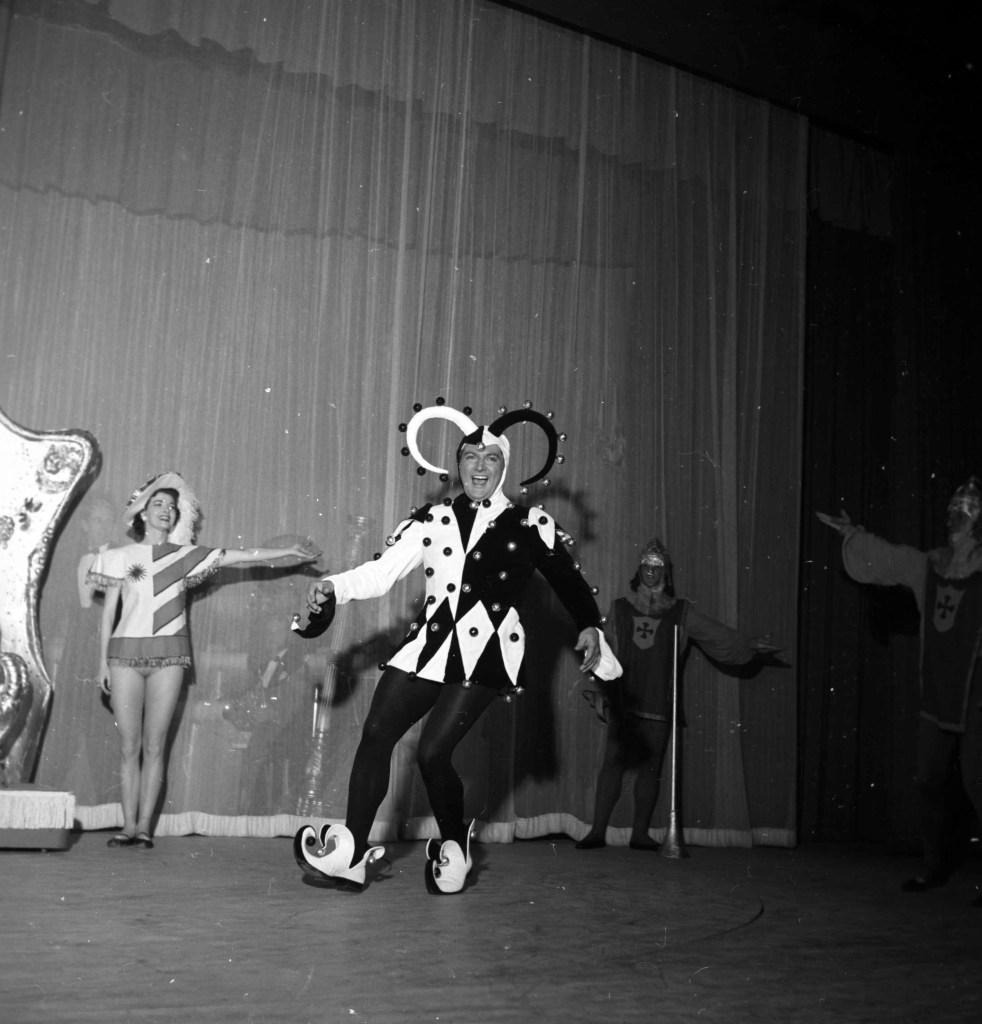
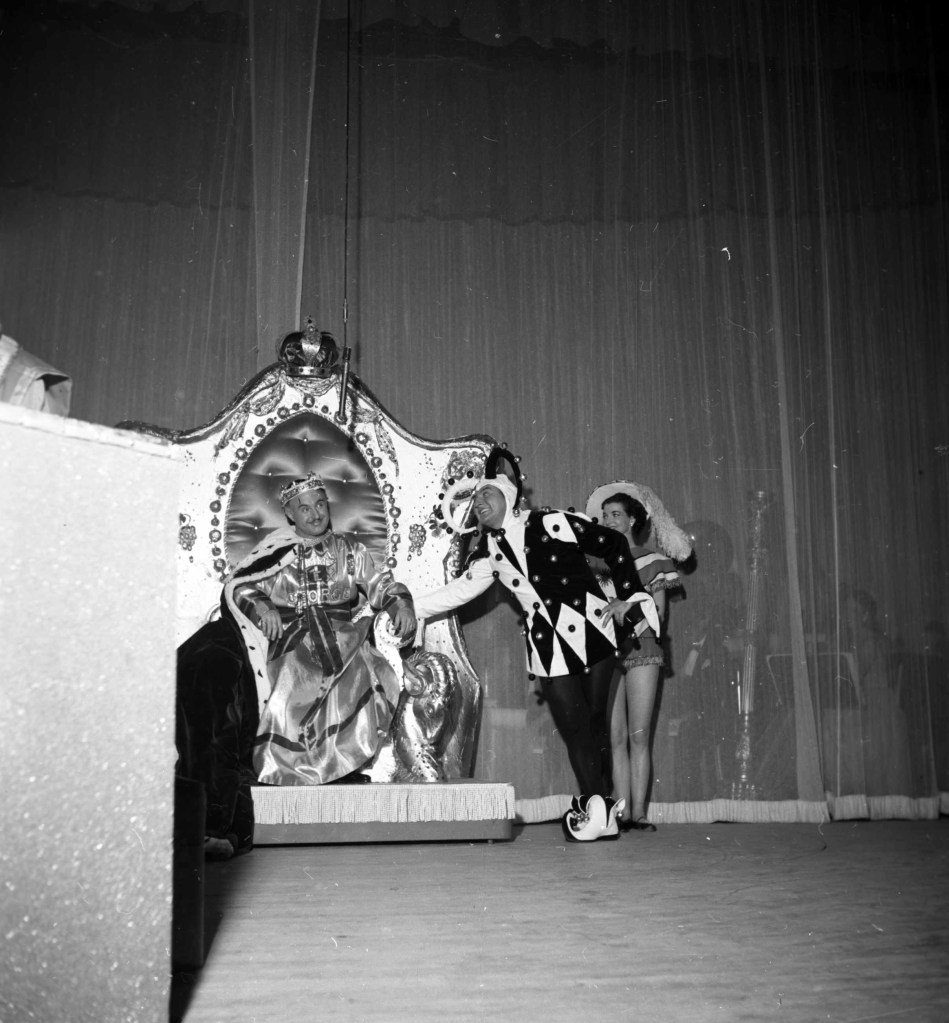
In Nurmi and Liberace’s version, Vampira would hypnotize Liberace, and bring him back in time to various versions of his past when he was everything from a flamboyant court jester to famed Austrian composer Johann Strauss.18 “After [Vampira] puts me to sleep, she asks me, ‘was there a time in your miserable joyous existence when you didn’t smile?’” Liberace told the Star Tribune in 1956. “Then we go back to the days of my concert with the Chicago symphony – we even have the same cellist who was with the symphony then – and I do a full concerto, 12 minutes, without smiling.”19
Also peppered throughout the show was Vampira’s signature graveyard humor which Liberace recalled he and Nurmi spent ample time perfecting during the writing process. “We wrote [the show] together [and Maila] has a big file of her particular kind of gags. I’d say, ‘do you have anything on dancing?’ She’d go through her file, and she usually had something we could use.”20
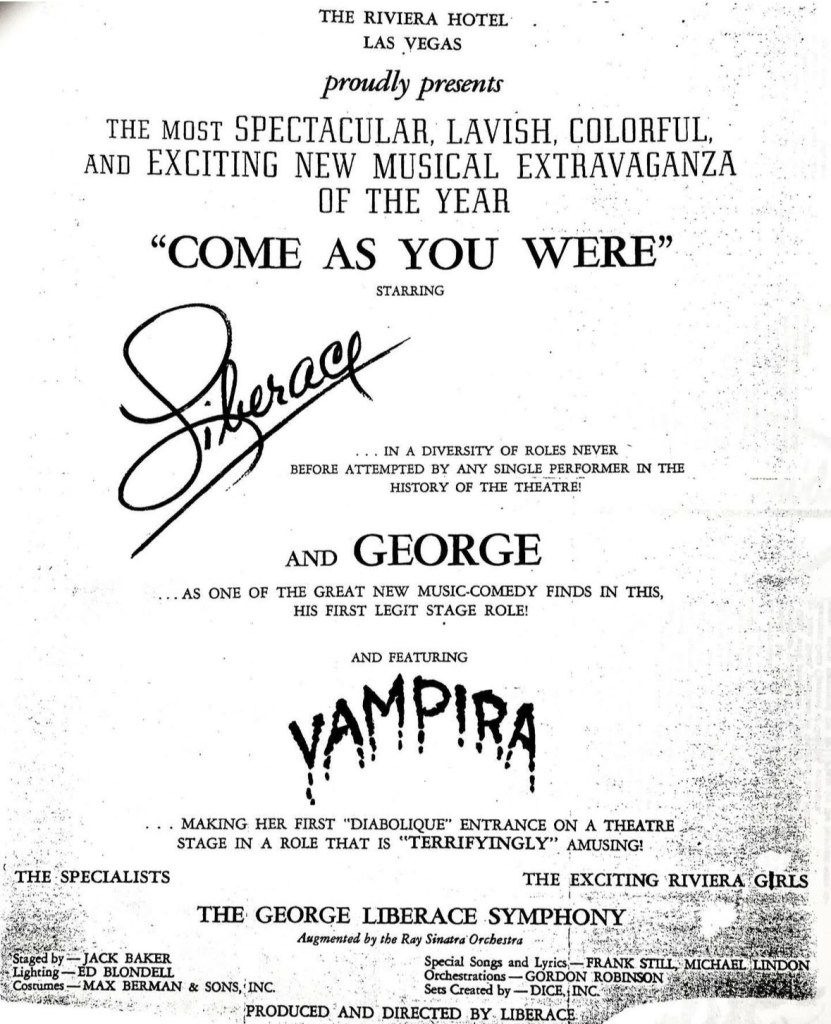
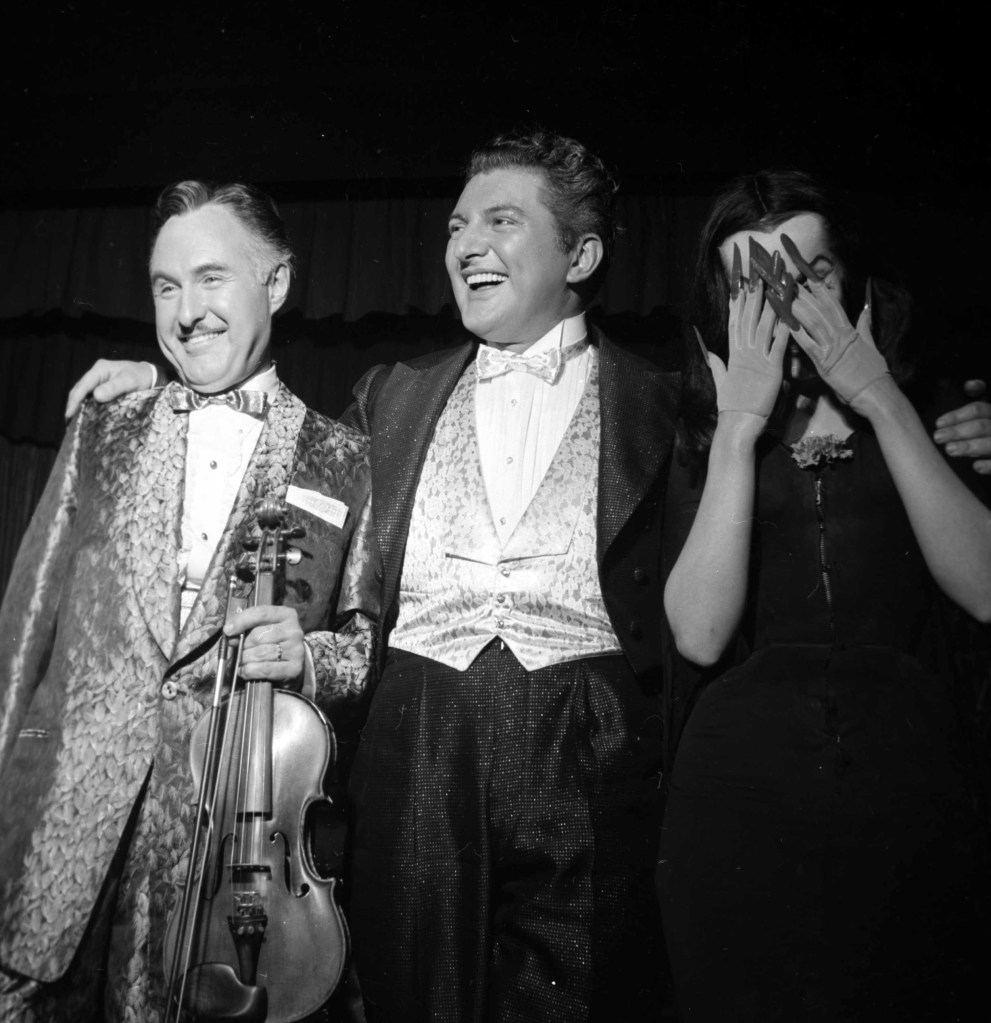
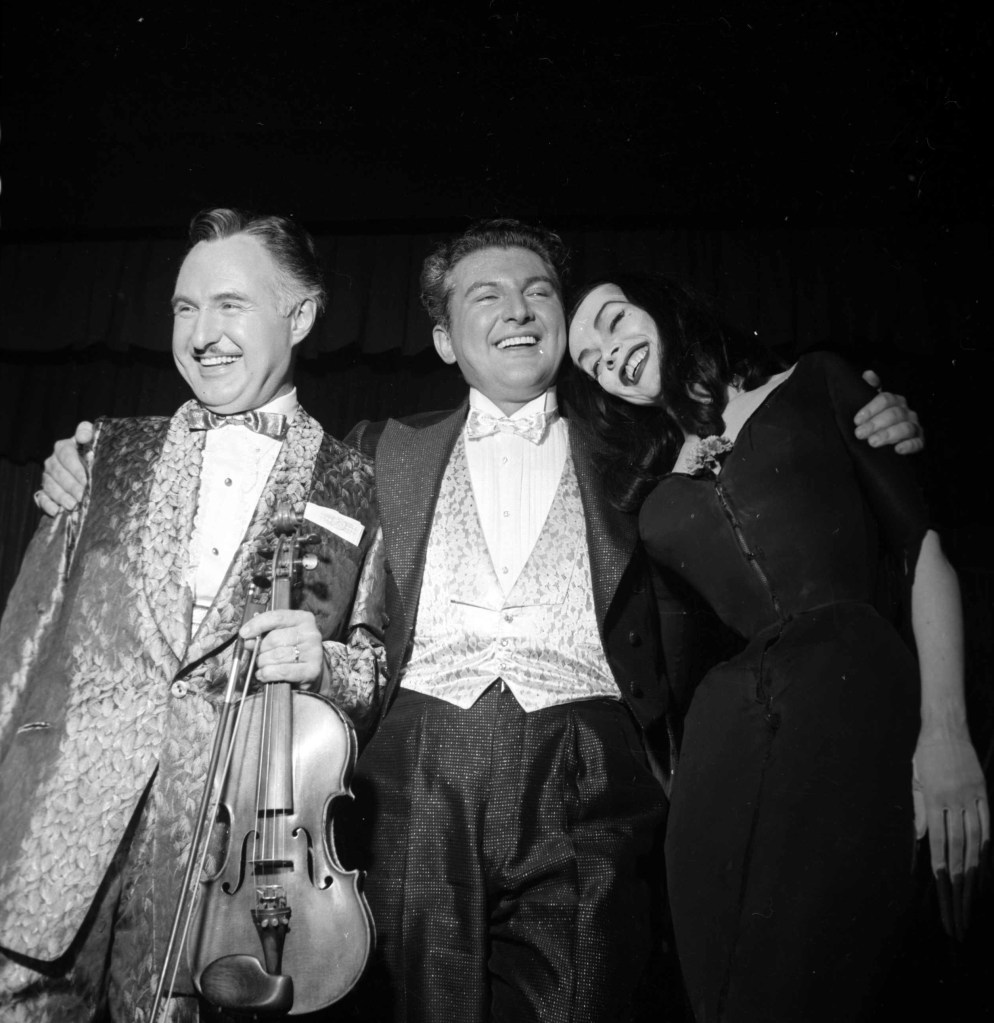
“Liberace’s Bridey” would debut under its new name “Come As You Were” on April 24th, 1956.21 Staged at the popular Riviera Hotel in Las Vegas, the show would open to sold out crowds and rave reviews for both Liberace and Maila Nurmi. “One of the most lavish productions to greet a Las Vegas audience in many months dazzled the Clover Room set at the Riviera tonight,” The Los Angeles Times reported. “If it were not for the hard working, quick changing [Liberace], Vampira would have stolen the show with a routine that included gag lines like ‘the morgue the merrier’ and ‘when I grow too old to scream, I’ll have you to dismember.’ […] The show was well tied together and moved fast for all its hour and 20 minutes of length.”22
(Photo credit: scan from author’s collection)
(Photo credit: LVCVA Archive/Las Vegas News Bureau)
(Photo credit: LVCVA Archive/Las Vegas News Bureau)
(Photo credit: LVCVA Archive/Las Vegas News Bureau)
(Photo credit: LVCVA Archive/Las Vegas News Bureau)
“Come As You Were” would mark the first and only appearance of the Vampira character on a national “theatrical stage.” 23 It would also mark a significant career resurgence for Maila Nurmi who – following KABC’s abrupt cancellation of The Vampira Show in 1955 – suffered a string of personal hardships that resulted in a “nervous breakdown” and a near-permanent retirement from show business.24 “Vampira [was] never [fully] done as I conceived her,” Nurmi told the Valley Times in 1956. “I see her as intelligent, sophisticated, macabre, caustic, and rhythmical. I would like her lit as a skull rather than a jack o’lantern. Know what I mean?”25
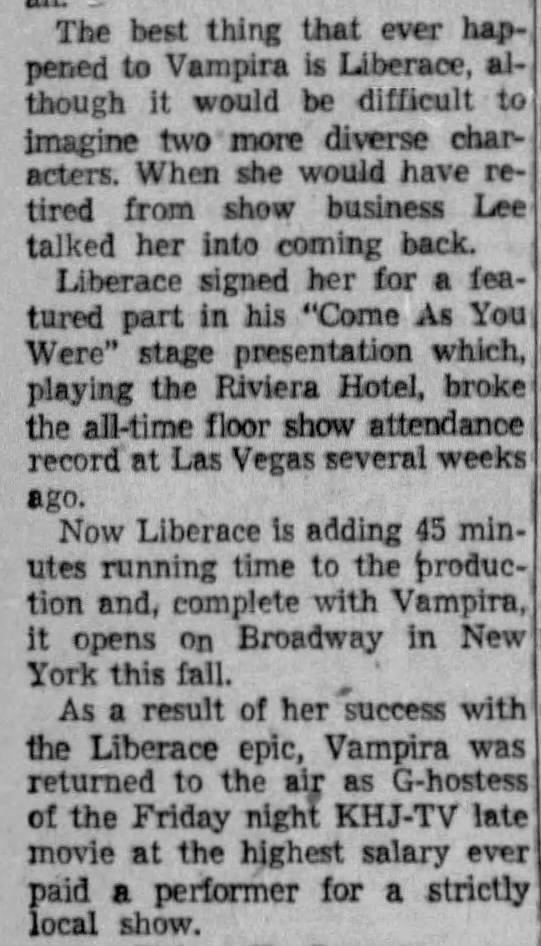
According to Nurmi, it was Liberace who expressed the greatest belief in both her and the Vampira character, “talk[ing] her into coming back” to show business in the hopes that she could find a second wind on another TV network.26 “The best thing that ever happened to Vampira is Liberace,” the Valley Times reported, noting that “Come As You Were” was so popular with Vegas crowds that it not only “broke [The Riviera’s] all-time floor show attendance record,” but also resulted in Vampira’s return to television on competing Los Angeles network KHJ-TV.27 “[She will now receive] the highest salary ever paid a performer for a strictly local show,” the Times confirmed.28
(Photo credit: Photo credit: LVCVA Archive/Las Vegas News Bureau)
(Photo credit: Photo credit: LVCVA Archive/Las Vegas News Bureau)
(Photo credit: The Valley Times)
Sadly, Maila Nurmi’s return to the spotlight on KHJ-TV would prove to be as short-lived as her original appearance on KABC. After filming for the second Vampira Show wrapped in 1957, Nurmi would make one final appearance as Vampira in the Ed Wood bomb Plan 9 From Outer Space before retiring the character for several decades.29 In 1981, Nurmi would again attempt to revive The Vampira Show on KHJ-TV, but would ultimately have the concept stolen out from under her and re-packaged as Elvira’s Movie Macabre.30 “[KHJ-TV] eventually called me in to sign a contract and [Elvira actress Cassandra Peterson] was there,” she told Bizarre magazine in 2005. “They had hired her without asking me.”31
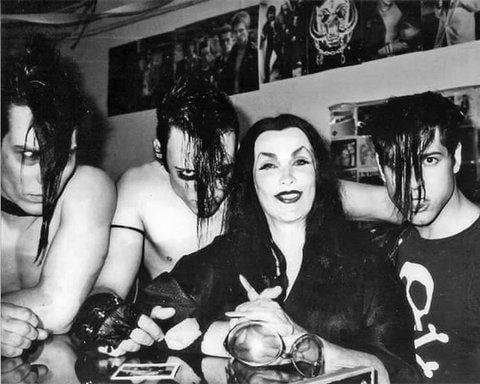
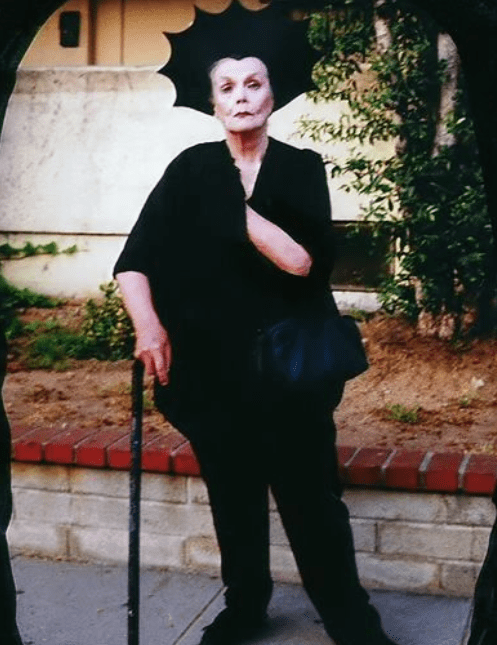
Unable to make ends meet as an actress or producer, Nurmi would find additional work as a furniture maker, jewelry designer, musician, writer, and boutique store owner until her death in 2008.32 “I’m a mixed media artist who’s very lazy and often doesn’t work at all,” she joked to Skip E. Lowe in 1988, “but when I do, I write short stories, I do illustrations, I write verse, I make necklaces, clothes for people. […] I was a bohemian in the early days, and then a beatnik. I never really quite got to be a hippie, but I was a mother of the hippies. I had a little shop for them and the flower children on Melrose [Avenue].”

(Photo credit: Listal)
(Photo credit: Pinterest)
(Photo credit: Vampira’s Attic)
While Maila Nurmi’s fame may never have reached the same heights as Liberace’s, her pioneering approach to fashion, entertainment, and showmanship remains deeply influential to this day. Nurmi opened the door for other horror hosts like Elvira and Svengoolie to thrive, and invented many of the make-up and fashion trends associated with goth and alternative subcultures since the 1980s.
For more on Maila Nurmi’s fascinating life and career, check out the wonderful, fan-made documentary Vampira and Me on Tubi. You can also watch some brief, surviving video footage of “Come As You Were” here.
Happy Halloween!
- W. Scott Poole, Vampira Dark Goddess of Horror (New York, NY: Soft Skull, 2014). ↩︎
- Vampira and Me, DVD (US: E1, 2012). ↩︎
- American Scary, film (US: Cinema Libre, 2009). ↩︎
- Ibid. ↩︎
- American Scary. ↩︎
- Ibid. ↩︎
- Vampira and Me. ↩︎
- Ibid. ↩︎
- The Vampira Show, 1954-1955. ↩︎
- Vampira and Me. ↩︎
- Ibid. ↩︎
- Will Jones, “Liberace New ‘Bridey Murphy,’” The Star Tribune, May 28, 1956. ↩︎
- Vampira and Me. ↩︎
- Ibid. ↩︎
- Allen Rich, “Listening Post and TV Review,” Valley Times, May 29, 1956. ↩︎
- Ibid. ↩︎
- Will Jones, “Liberace New ‘Bridey Murphy,’” The Star Tribune, May 28, 1956. ↩︎
- Ibid. ↩︎
- Ibid. ↩︎
- Ibid. ↩︎
- “Liberace Versatile in Show at Riviera,” The Los Angeles Times, April 25, 1956. ↩︎
- Ibid. ↩︎
- “Come As You Are” program (pictured). ↩︎
- Rich. ↩︎
- Ibid. ↩︎
- Ibid. ↩︎
- Ibid. ↩︎
- Ibid. ↩︎
- Vampira and Me. ↩︎
- Ibid. ↩︎
- “Vampira Interview”. Bizarre. January 2008. Archived from the original on February 9, 2012. ↩︎
- Vampira and Me. ↩︎

 Beyond The Candelabra
Leave a comment