
Happy World AIDS Day. 🕯️ Today, we honor the lives of the millions lost to HIV AIDS, including Liberace and his longtime partner Cary-James.
Liberace first learned he was HIV positive in the summer of 1985.1 According to Cary-James, the discovery was made during a routine medical examination in which Liberace was told that he’d not only tested positive for the virus, but had also exposed James to its dangers.2 Horrified and guilt-ridden, Liberace immediately began to retreat back inside the glass closet he’d only just begun to come out of, begging Cary-James not to share the truth of their diagnoses with anyone, and vehemently denying he had the virus to friends, fans, and the mass media.3 “False rumors [have] started to circulate about my health,” he wrote in his last book The Wonderful Private World of Liberace. “According to the gossips, you name it, and I had it. Let me assure you, I’ve never felt better in my life!”4
But despite Liberace’s best efforts to convince the world that he was feeling better than ever, rumors about his worsening health continued to proliferate. Tabloids like Star magazine set the tone for unethical reporting on Liberace’s condition when they made the bold (and likely illegal) decision to publish his and Cary-James’ leaked hospital admittance records in 1985.5 Other outlets like The National Enquirer stuck to speculation and gossip from “inside sources” only, chalking Liberace’s noticeable weight loss up to a possible battle with cancer or HIV.6 “Liberace was once robust and healthy,” the Enquirer reported in 1987. “Today, he’s lost a lot of weight and looks gaunt.”7

(Photo credit: The National Enquirer)
Fan and media speculation about Liberace’s health would come to a head on January 24th, 1987 when the Las Vegas Sun became the first publication to “officially” report that Liberace was dying from AIDS.8 The Sun‘s report was published without Liberace’s consent, and took on a bizarre, almost patronizing tone which Liberace biographer Darden Asbury Pyron described as “an Orwellian combination of sympathy, concern, and morbid curiosity.”9 Prior to its report on January 24th, the Sun had also published a piece on January 14th baiting Liberace to come forward on his “own” or risk the Sun doing it for him.10 “In lonely desperation one of entertainment’s brightest stars has sealed himself from the rest of the world because he cannot or will not face the fact that he might be dying from AIDS,” editor Hank Greenspun wrote. “We urge the victim to face reality with courage and determination to lick the disease if there is a way.”11
Although fatally ill by the time the Sun’s second report hit shelves, Liberace remained defiant in the lead up to its publication, directing his attorney to sue anyone who claimed he had AIDS, and directing his publicists and manager to insist he was suffering from anemia after experimenting with a failed “watermelon diet” in 1985.12 It wasn’t until the Riverside County coroner, Ray Carrillo, ordered an official investigation into Liberace’s death in 1987 that that the world would finally learn the truth Cary-James had dutifully protected since 1985: Liberace was, in fact, a “victim of deadly AIDS.”1314
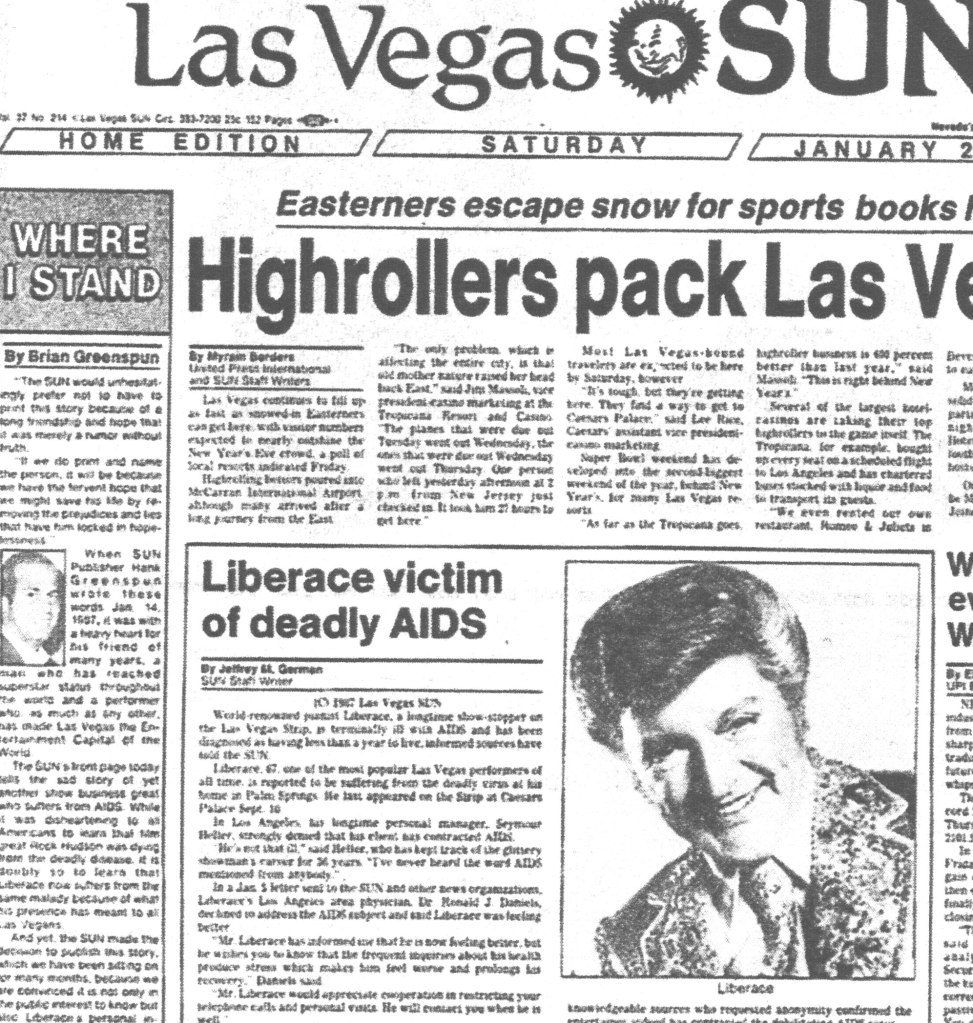
(Photo credit: Las Vegas Sun)
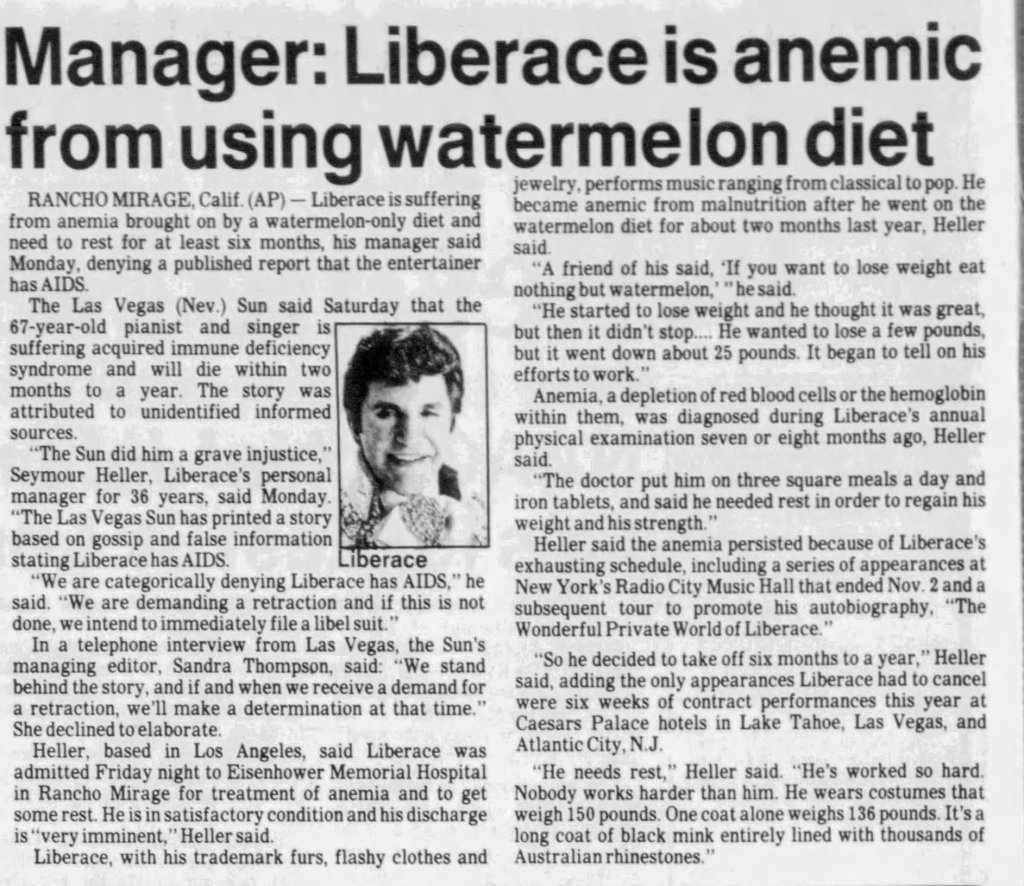
(Photo credit: The Belleville-News Democrat)
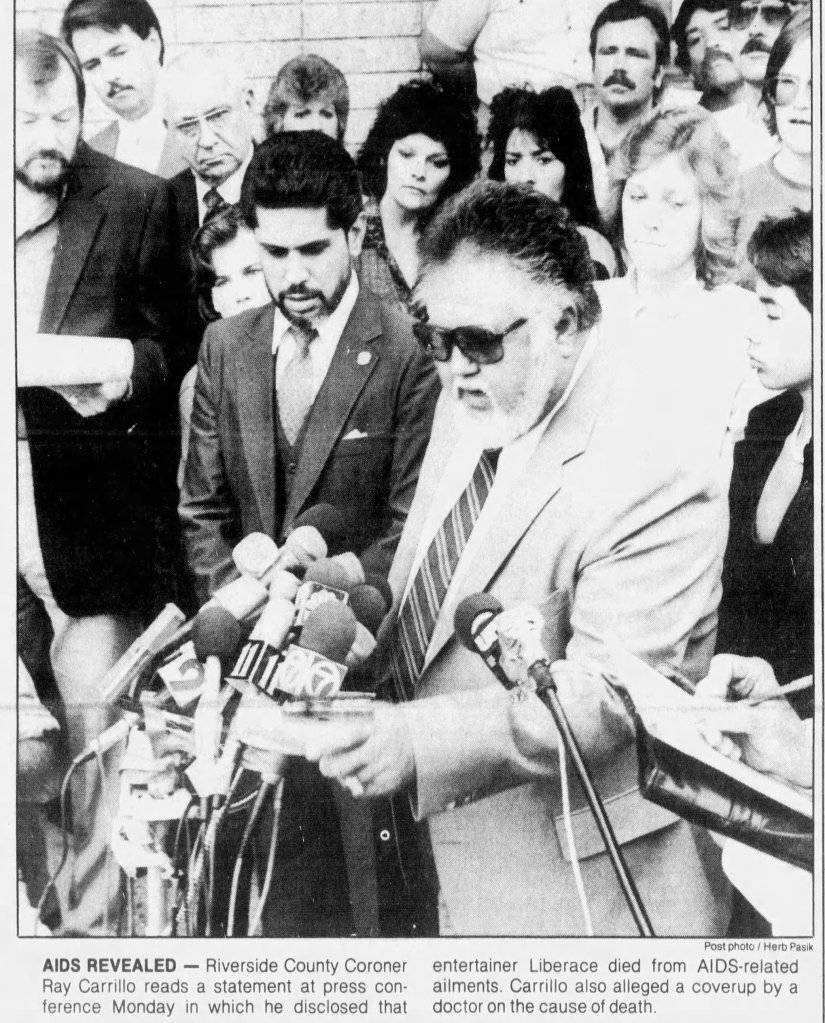
(Photo credit: Palm Desert Post/Herb Pask)
The confirmation that Liberace had lied about his HIV status angered many gay and AIDS rights activists who would go on to brand Liberace a “coward,” and argue that he should’ve used his massive wealth and celebrity to raise awareness for the stigmatized disease.15 “There are only two villains in the story of Liberace’s death,” one critic from The Illinois Times concluded, “a deadly virus we know very little about, and a frightened self-centered entertainer who missed his chance to help us combat it.”16
Other commentators, like senior vice president of the American Medical Association James Todd, argued that Liberace was well within his rights to protect his medical privacy, and that the media’s obsession with proving he had AIDS wasn’t motivated by activism or concern, but by a frenzied need to out a gay man who’d long evaded their capture. “Of what benefit is it to the general public to know that Liberace died of AIDS?” Todd rhetorically asked Reuters. “Is that useful in anything other than gaining front-page coverage of the fact that he died?”17
Fiercely protective of Liberace in both life and death, Cary-James would offer few insights into his partner’s motivations until shortly before his own death from AIDS in 1995. Finally breaking his silence in an interview with The National Enquirer, James recalled that Liberace was plagued by feelings of guilt and shame about his diagnosis, and that he remained almost pathologically convinced that his legions of straight, female fans would turn on him if he ever confirmed he was gay or suffering from HIV.18 “He didn’t want the public to know [we were in a relationship so] he put me on the books as a household employee,” James told the Enquirer. “His worst fear was that his fans would find out he was gay.”19

(Photo credit: The National Enquirer)
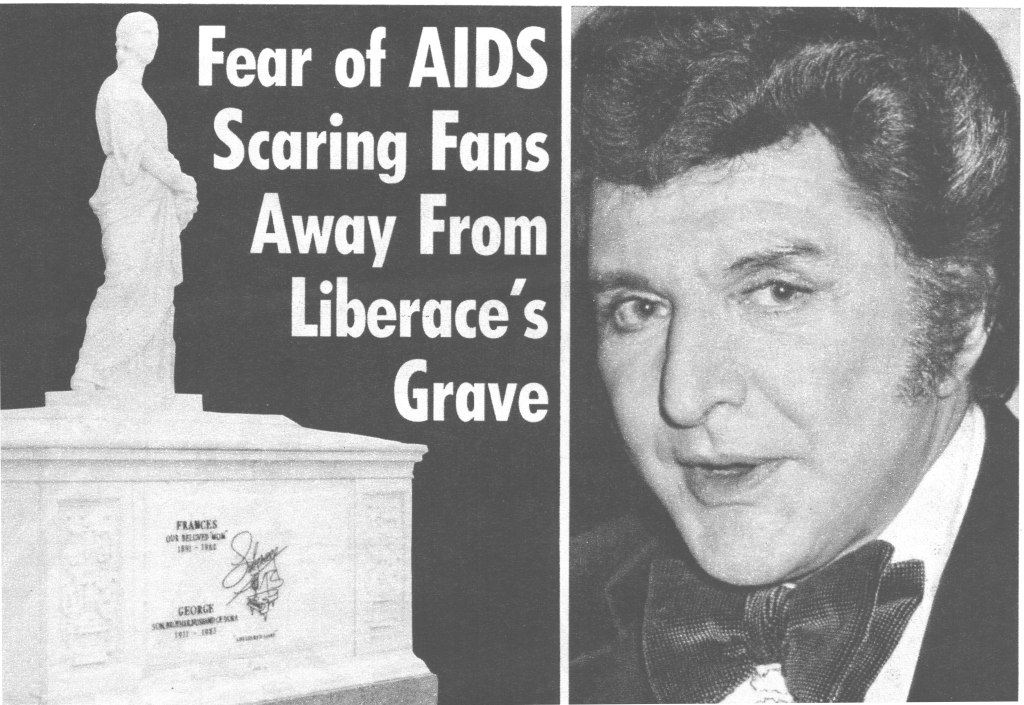
(Photo credit: The National Enquirer)
While Liberace’s behavior may have come off as weak or cowardly to some gay audiences, Cary-James clearly preferred to view his partner’s fears through the more empathetic lens of historical reality. Born just 22 years after Oscar Wilde was jailed for publicly professing his homosexuality in 1897, Liberace was raised in a radically different world than any of his post-Stonewall critics, and spoke at length about how even being accused of being gay in the 1950s nearly destroyed his life and career. “It hurt me,” he told writers Karl and Anne Taylor Fleming in 1975. “People stayed away from my shows in droves. I went from the top to the bottom in a very short amount of time, and I had to fight for my life.”20
Bob Thomas, a veteran Hollywood reporter who wrote the first biography of Liberace in 1987, would join Cary-James in defending Liberace’s perspective during a 1989 interview with America’s leading gay lifestyle magazine, The Advocate. “You must remember that [Liberace came from] a different era,” he told reporter Kim Garfield, “when [coming out as gay] would be ruinous, both personally and professionally. […Liberace] realized that [being gay] was part of his psyche and that he could never go public with it. And he never did.”21
Acknowledging the comparisons gay critics often drew between Liberace and the more revered Rock Hudson, Thomas would argue that – contrary to the successive myth-making which surrounded Hudson in the years following his death – he had also never been a gay rights activist, and had only revealed his own battle with HIV after receiving similar threats to out him from the mass media.22 “There was a lot of denial [from Rock Hudson about his homosexuality and HIV diagnosis] at the onset,” Thomas told Garfield. “And once it was revealed, I’d like to think that Hudson affirmed it on a humanitarian basis. But if it hadn’t been leaked to the press – would he have admitted it? I don’t know.”23

(Photo credit: Standard-Speaker)
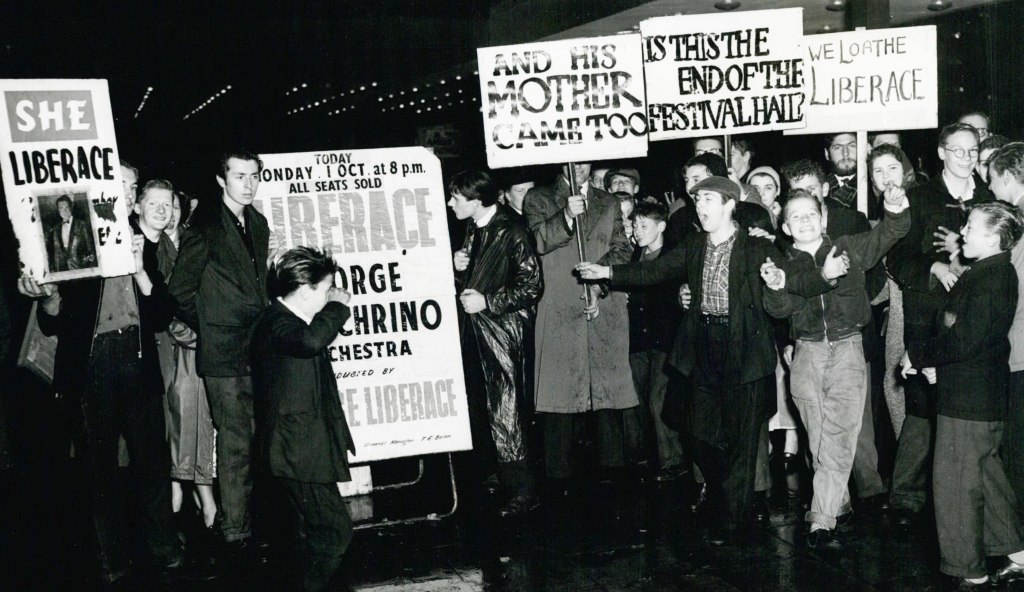
(Photo credit: Keystone Press)
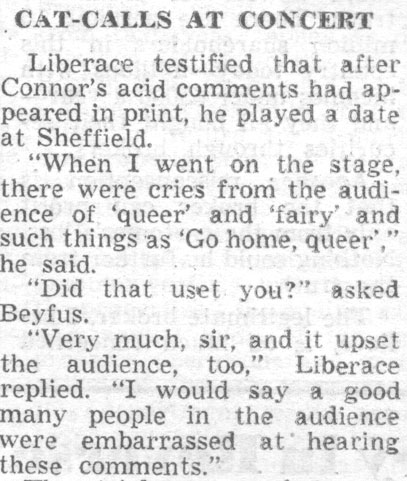
(Photo credit: The Boston American)
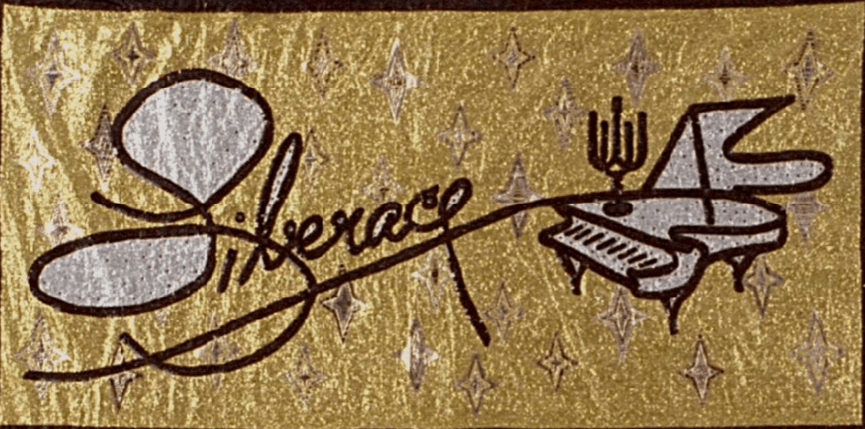
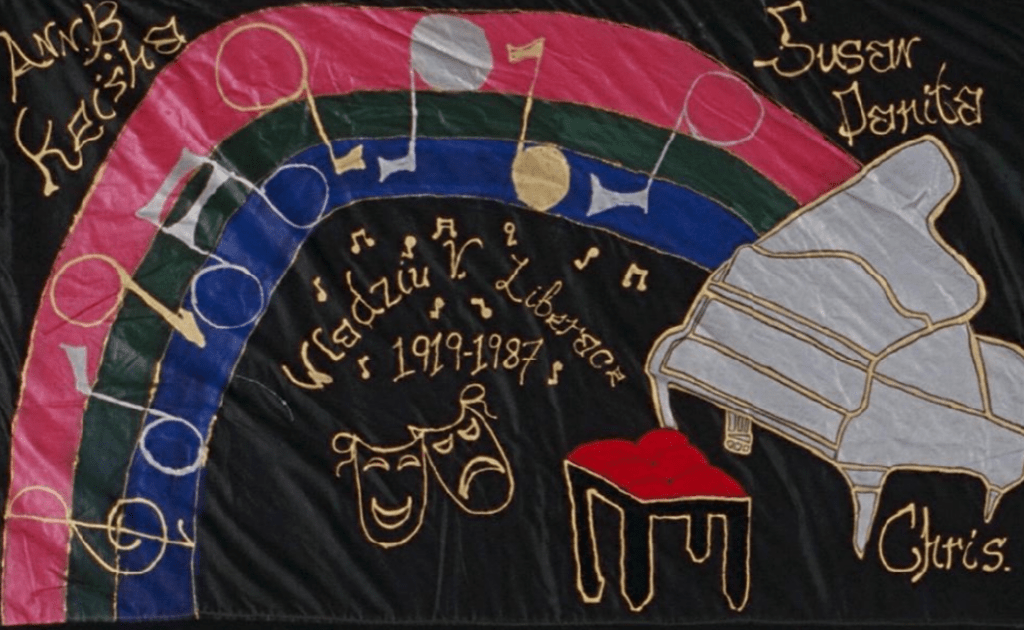
(Photo credit: National AIDS Memorial)
Still, Liberace’s decision not to allocate any of his multi-million dollar estate to AIDS charities or research remains a legitimate point of critique, and one which – as a gay Liberace fan myself – I feel a responsibility to address and correct as much as possible. So this World AIDS Day, I hope you’ll join me in making a monetary contribution to amfAR.
amfAR (or the American Foundation for AIDS Research) is an internationally recognized organization dedicated to supporting HIV AIDS prevention, research, and education. Founded by gay icon and Liberace acquaintance Elizabeth Taylor in 1985, amfAR has invested over $900 million in global AIDS research, and is currently offering a match for all donations made on World AIDS Day.
As Elizabeth Taylor would often remind us, people with HIV AIDS are our friends, family, and neighbors. They struggle with discrimination, shame, isolation, pain, and poor medical access. And they suffer from a disease that should never be viewed as a poor reflection upon anyone’s character, humanity, or sexuality.
Together, we can work to put an end to the crisis that’s claimed so many lives in our community and beyond.

- Darden Asbury Pyron, Liberace: An American Boy (Chicago, IL: The University of Chicago Press, 2000). ↩︎
- Ibid. ↩︎
- Ibid. ↩︎
- Liberace, The Wonderful Private World of Liberace (New York, New York: Harper & Row Publishers, 1986), 28. ↩︎
- Rod Barrand, “Liberace Health Fears,” Star, 1985. ↩︎
- “Liberace’s Desparate Battle,” The National Enquirer, 1986. ↩︎
- Ibid. ↩︎
- Pyron. ↩︎
- Ibid. ↩︎
- Ibid. ↩︎
- Ibid. ↩︎
- Ibid. ↩︎
- Herb Pasik, “AIDS Revealed,” Palm Desert Post, February 11, 1987. ↩︎
- Pyron. ↩︎
- Dave Ambrose, “Villains and Viruses,” Illinois Times, February 26, 1987. ↩︎
- Ibid. ↩︎
- Reuter’s, “Right to Privacy,” Waterloo Region Record, February 12, 1987. ↩︎
- Pyron. ↩︎
- Qtd in Ibid. ↩︎
- Karl Fleming and Anne Taylor Fleming, The First Time, 1975, 142-3. ↩︎
- Kim Garfield, “Liberace: Taking the Wraps off the Legend That Was,” The Advocate, April 26, 1988, 50. ↩︎
- Ibid, 51. ↩︎
- Ibid, 51. ↩︎

 Beyond The Candelabra